
WELCOME TO MINNENAS STIG,
the cultural trail through the villages of
Norrby, Bergby and Västerkulla
in Häverö parish.
A cultural trail is a hiking trail that tells a local story by connecting places of cultural and historical interest. The goal of the cultural trail Minnenas stig is to document and present the exciting history of the region in an easily accessible way. Minnenas stig was developed by Bergby Skolas Bygdegårdsförening in a study circle in 2025. The project has been implemented with financial support from Norrtälje Municipality’s rural and archipelago development funds.
The Trail of Memories consists of four marked loops of different lengths. All loops start and end at Bergby Skolas Bygdegård (formerly Bergby Folkskola), but it is also possible to start and end the hike at other locations. The trails alternate between roads and nature trails. At several locations there are information boards with maps and parking options. Along the trails are around thirty signs placed, with information about interesting buildings, people and events in the villages. The signs are numbered and provided with QR codes that lead to the Bygdegårdsföreningen’s website, where there is additional material about the trail and the area.
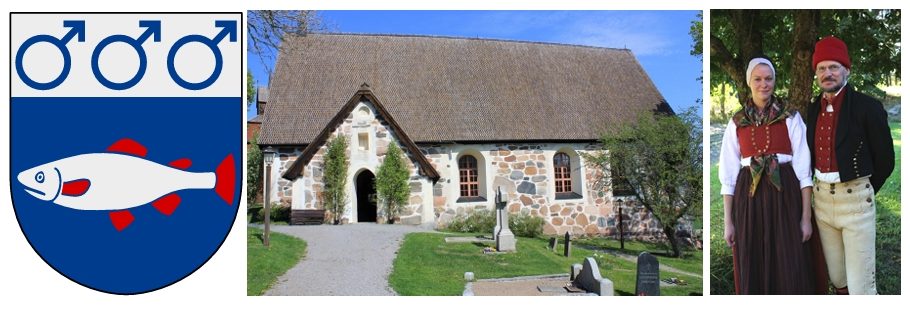
Häverö parish is located in Roslagen in Uppland and is surrounded by water on three sides. From Edeboviken in the west to Väddöviken in the east and to Singöfjärden in the north. In the south, Häverö borders the parishes of Väddö and Ununge. Häverö parish was formed during the Middle Ages. A parish is an administrative area around a congregation with a priest and church. Häverö church is a very beautiful medieval stone church from the 14th century located in the middle of the parish. The Häverö costume is a folk costume from Häverö parish – one of the few original folk costumes from Uppland. Häverö parish consists of about 40 villages, most of which are known from the 15th and 16th centuries. The central town of Häverö parish today is Hallstavik. In the middle of the parish is Häverö church. With the municipal reform of 1862, the parish’s responsibility for church matters was transferred to Häverö parish and for civil matters to Häverö county municipality. In 1971, Häverö municipality was incorporated into Norrtälje municipality.
Häverö and Väddö skeppslag were part of the medieval Uppland folkland Roden (Roslagen) and were formed as early as the 13th century with the task of equipping a boat with rowers for ledung (war service). Skeppslagen was also a district for the administration of justice. Courts are held three times a year in various villages, including Norrby, at Häverö church and in Ortala. A permanent courthouse was not created until 1924 when a courthouse was built in the national romantic style in Häverödal. Skeppslagen survived until the 20th century and in 1948 was absorbed into what later became Norrtälje District Court.
Our homeland consists of Norrby, Bergby and Västerkulla villages in Häverö Parish. Settlements probably arose here as early as the Iron Age (500 BC to 1050 AD). Norrby and Bergby are so-called ’bolbyar’ (or odalbyar), which include a collection of farms where self-owned monks live. Norrby is one of the larger villages in Häverö parish, the name Norrby has been known since 1429. Bergby also has a long history, probably from the Viking Age. The name is documented in writing as early as 1409. The first known map of the village dates back to 1640. Västerkulla village is a separate (separate) village from Bergby, originally called Bergby Västergård. The villages formerly included several outlying areas; Bergboö, Hammarskogen, Prästskaten and Haga. The outlying areas were the villages’ common lands and were used for grazing, timber harvesting, leaf removal and coal beds. Today, the outlying areas include nature conservation areas and plots of land.
We welcome all local residents and visitors to take part in the history and cultural landscape of the town by walking or cycling along the cultural trail. The trail of memories is based on the right of public access, and we ask everyone to show consideration by respecting the peace and quiet of their homes and not stepping on private land or areas.
Welcome!
Map – The trail of memories (Minnenas stig)
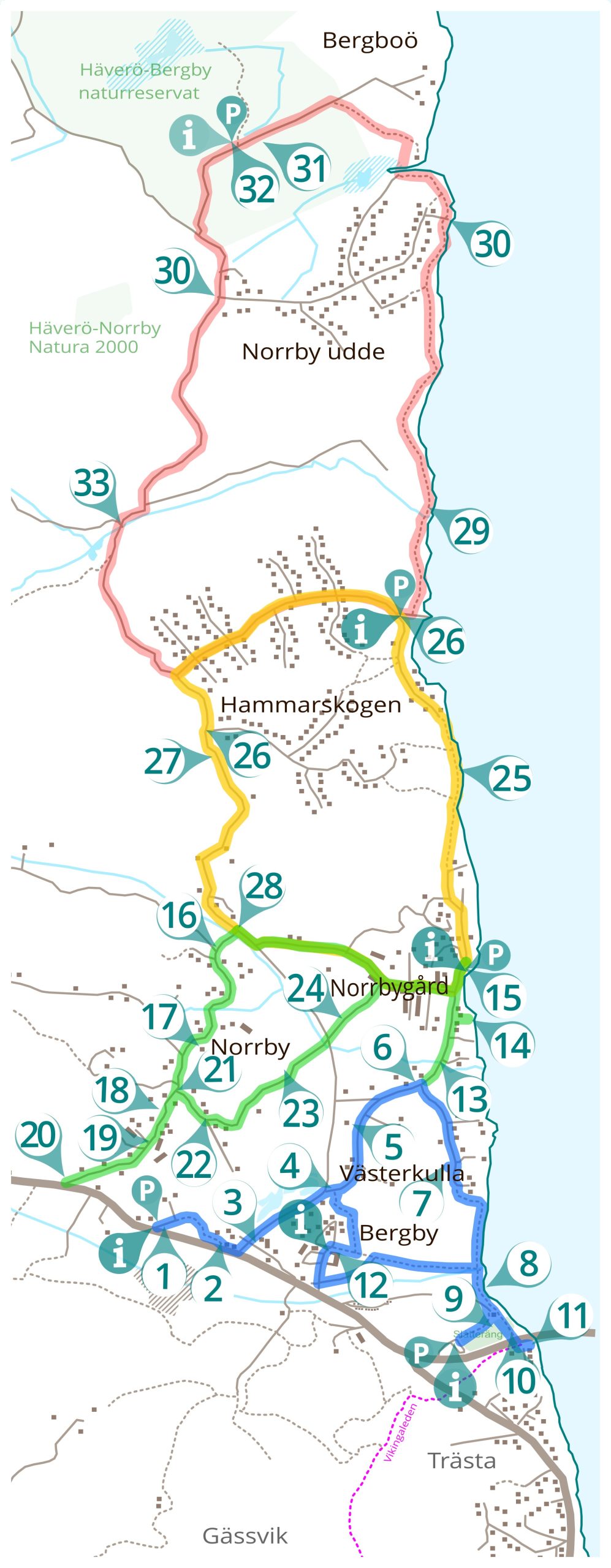
Map symbols

Information sign

Parking

Signpost
The trails and signposts
If you want to walk all four loops on our cultural trail at the same time (in numerical order from no. 1 to no. 33), it will be almost three miles (about 28.5 km) to walk before you are back at no. 1 Bergby Skolas Bygdegård again.
To find out more about a sign location, click on the respective sign name in the menus and you will be taken to a page with information about that particular location.
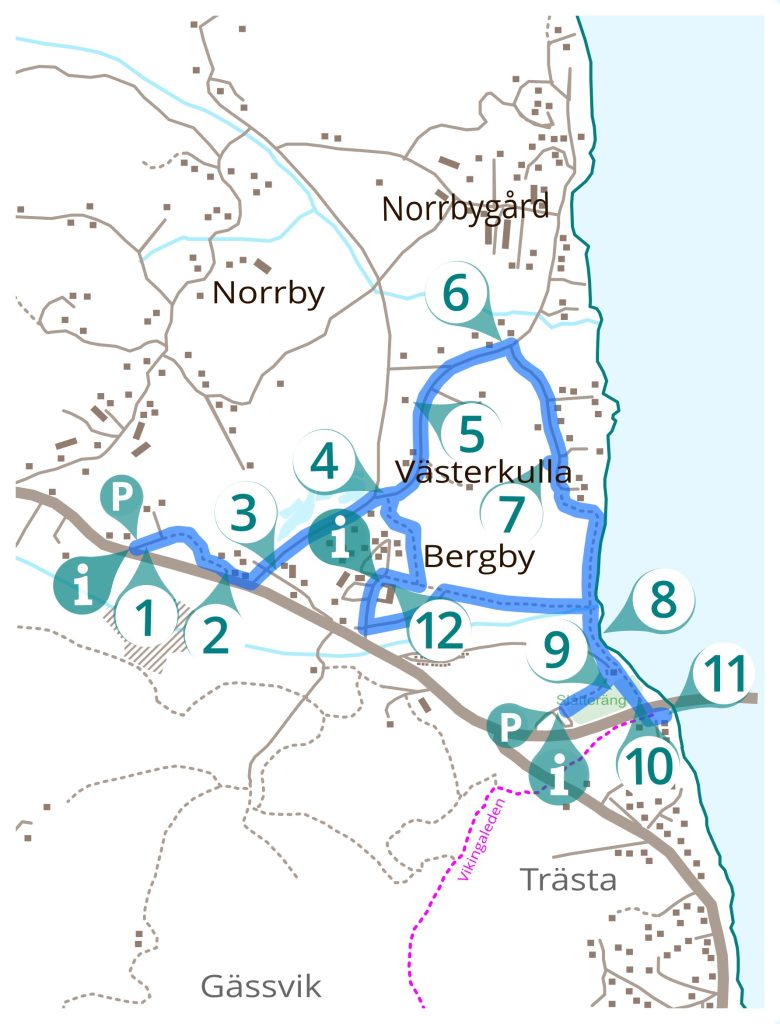
BERGBY-VÄSTERKULLA
Blue loop · approx. 6 km back to the community center
Partly on nature trail. Accessible to everyone on foot and by bike. Not suitable for frame walkers or wheelchairs.
6 km, takes about 75 min. at a normal walking pace.
NORRBY
Green loop (approx. 6 km, + approx. 3 km return to the community center)
On roads. Easily accessible for everyone.
6 km, takes about 1 hr. and 15 min. at a normal walking pace.
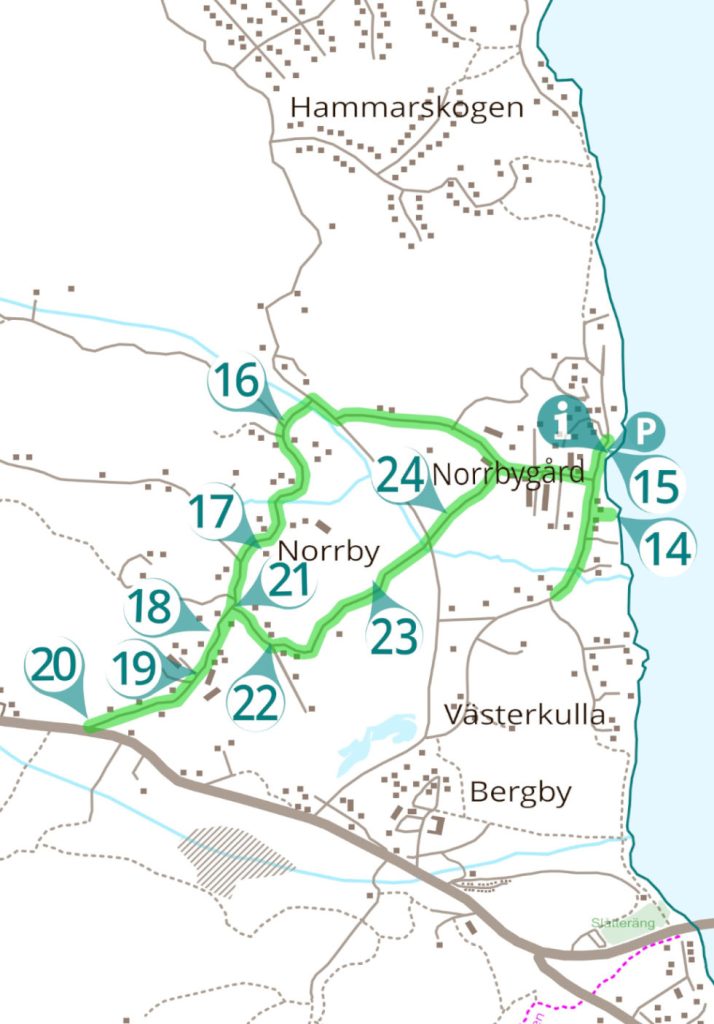
HAMMARSKOGEN
Yellow loop (approx. 5 km + approx. 4 km round trip to the community centre)
Mainly on roads. Accessible to all on foot and by bike. Rollator and wheelchair work with assistance.
5 km, takes about 60 min. to walk at a walking pace.
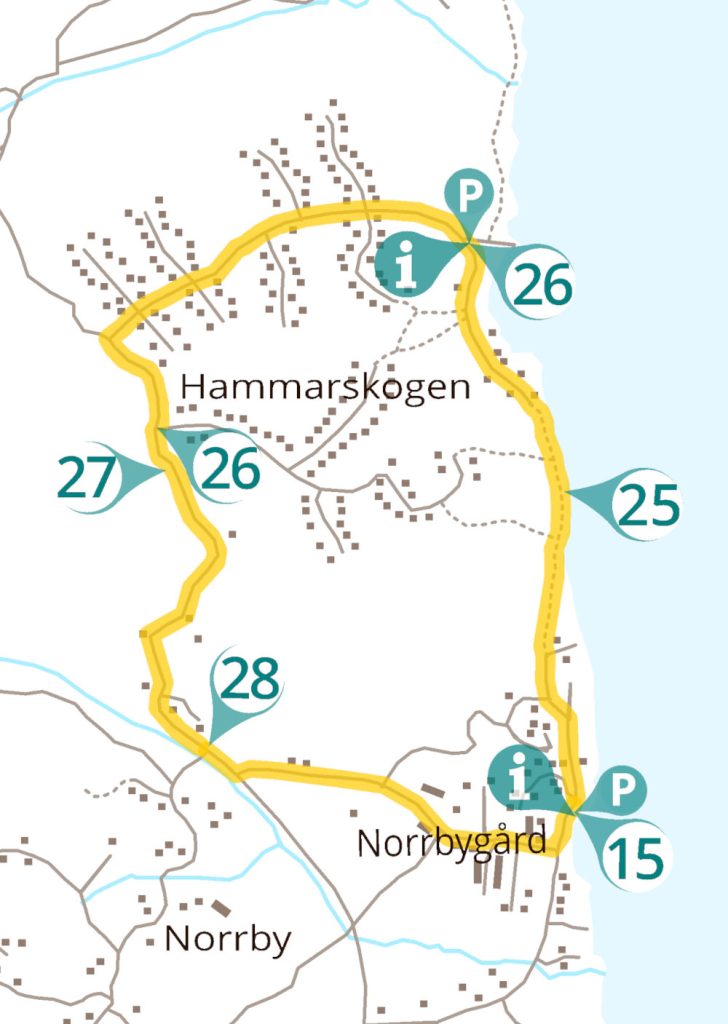
BERGBOÖ
Red loop (approx. 7 km + approx. 7,5 km round trip to the community centre)
On nature trails and roads. Accessible to everyone on foot. Not suitable for bicycles, strollers, walkers or wheelchairs.
7 km, takes about 1 hr. and 30 min. to walk at a walking pace.
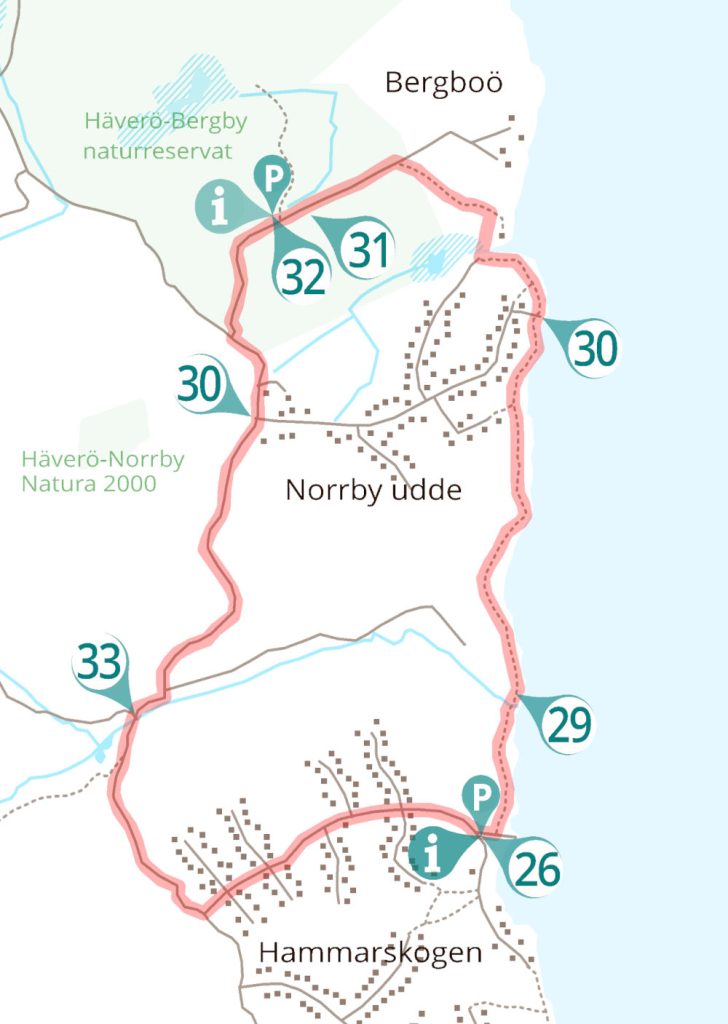
Map – Häverö parish
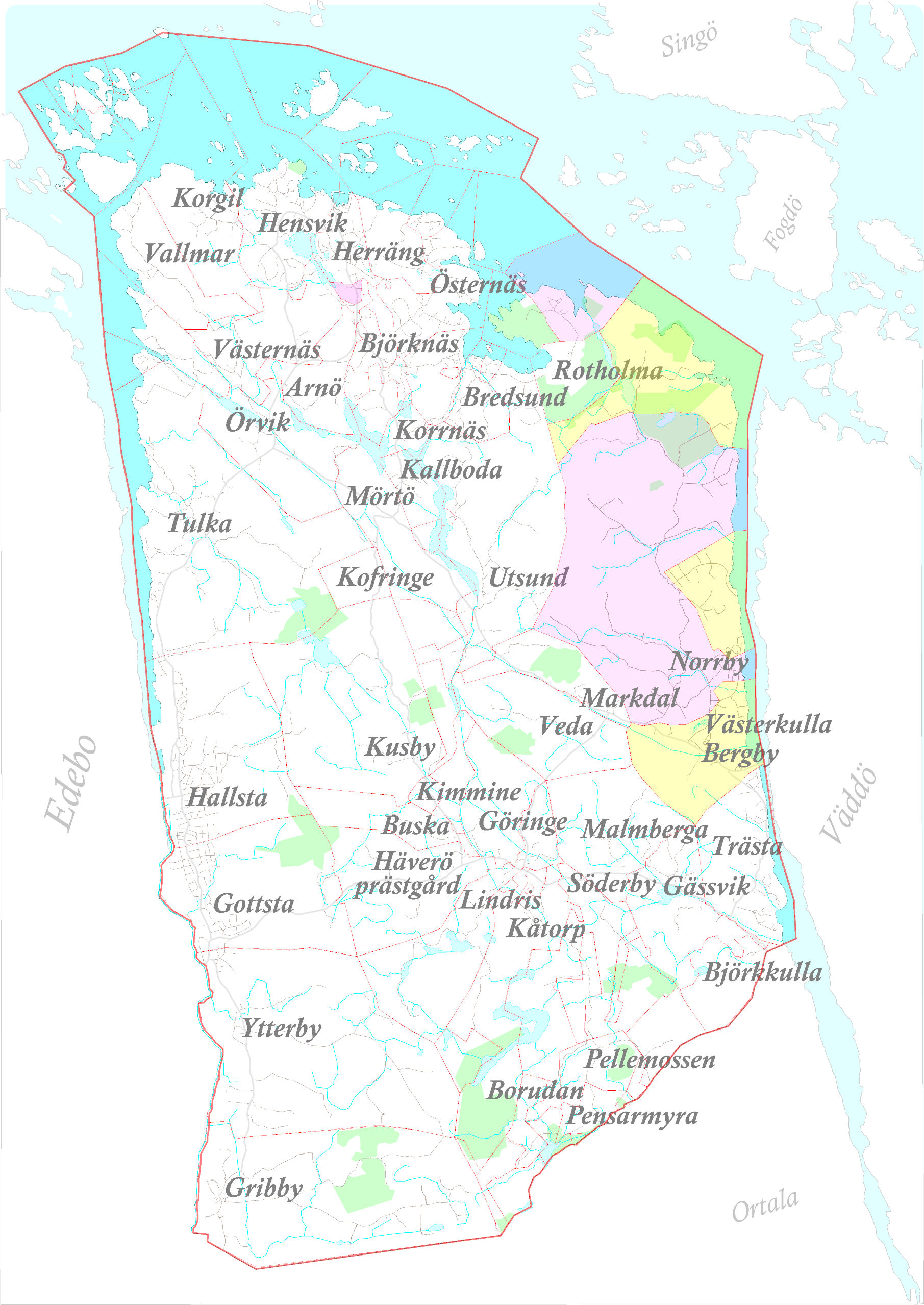
The 40+ villages of Häverö: Arnö, Bergby, Björkkulla, Björknäs, Borudan, Bredsund, Buska, Gottsta, Gribby, Gässvik, Göringe, Hallsta, Hensvik, Herräng, Häverö prästgård, Kallboda, Kimmine, Kofringe, Korgil, Korrnäs, Kusby, Kåtorp, Lindris, Malmberga, Markdal, Mörtö, Norrby, Pellemossen, Pensarmyra, Rotholma, Söderby, Trästa, Tulka, Utsund, Vallmar, Veda, Västerkulla, Västernäs, Ytterby, Örvik and Östernäs (incl. Nybyn).
Senast uppdaterat kl. 11:19, tisdag 30 december 2025